NYSE Owner Moves Into Bitcoin-Backed Lending As Wall Street Adoption Grows
英語の原文翻訳を見る
文字サイズ本文を読む ↓
画像を読み込み中
Bitcoin is becoming more deeply integrated into Wall Street’s financial infrastructure. Intercontinental Exchange (ICE), the parent company of the New York Stock Exchange, has partnered with digital asset financial services provider Abra to support institutional lending backed by Bitcoin, Ethereum, and Solana. The development creates another opportunity for institutions to access liquidity without immediately selling […]

Bitcoin is becoming more deeply integrated into Wall Street’s financial infrastructure. Intercontinental Exchange (ICE), the parent company of the New York Stock Exchange, has partnered with digital asset financial services provider Abra to support institutional lending backed by Bitcoin, Ethereum, and Solana. The development creates another opportunity for institutions to access liquidity without immediately selling their cryptocurrency holdings.
The announcement marks another milestone in Bitcoin’s institutional adoption, as traditional financial companies increasingly explore how digital assets can function within established lending and custody systems.
According to the official announcement published on November 16, ICE Digital Trust will provide qualified custody for collateral supporting loans originated by Abra Credit.
Eligible institutional borrowers can pledge Bitcoin, Ether, or Solana and receive US dollar loans while their cryptocurrency remains in segregated custody accounts.
The arrangement is already available to an initial group of institutional clients.
NYSE Parent Brings Bitcoin Into Traditional Lending Infrastructure
The partnership introduces a structure designed to address an important concern in cryptocurrency-backed lending: who controls the pledged assets.
Under the agreement, ICE Digital Trust will hold the collateral, while Abra Credit will originate loans, manage lending operations, and monitor collateral values around the clock.
Importantly, the pledged assets will not be rehypothecated, meaning the lender cannot reuse them to support additional borrowing.
This creates a separation between asset custody and lending operations, similar to arrangements already familiar to traditional financial institutions.
Abra founder and CEO Bill Barhydt highlighted the significance of the development, explaining that borrowers have historically needed to trust their lenders with custody of their Bitcoin.
The new structure instead places the collateral with an independent qualified custodian owned by the company operating the New York Stock Exchange.
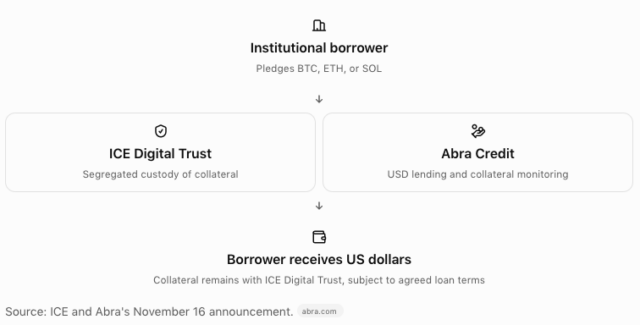
ICE Digital Trust will release collateral only according to controls agreed upon by the borrower, Abra Credit, and the custodian.
However, pledged assets can still be liquidated if collateral requirements are breached or a borrower defaults.
Bitcoin Holders Gain Another Way To Access Liquidity
One of the most encouraging aspects of the partnership is the opportunity for institutions to unlock liquidity while maintaining exposure to Bitcoin.
Rather than selling BTC to raise capital, an eligible borrower can pledge it as collateral for a dollar-denominated loan.
This could become particularly useful for institutional investors managing long-term Bitcoin positions alongside short-term liquidity requirements.
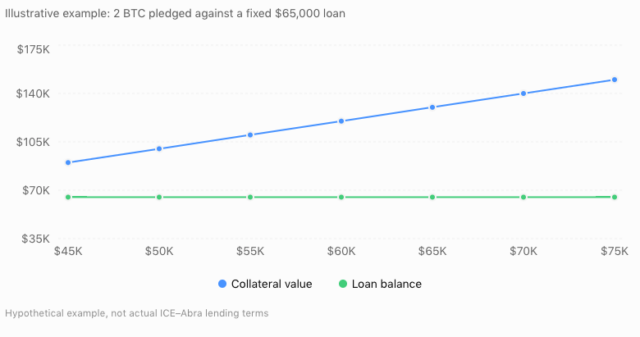
For example, a borrower holding $10 million in Bitcoin could theoretically obtain a $5 million loan at a 50% loan-to-value ratio, provided those terms were offered and approved.
The borrower would retain exposure to Bitcoin’s price movements while accessing dollars for other financial purposes.
However, the arrangement also introduces risks. A significant decline in Bitcoin’s value could require additional collateral or result in liquidation.
We believe the broader significance lies in the expansion of Bitcoin’s financial utility.
As previously reported by Bitcoinist, traditional financial institutions have been exploring new ways to integrate cryptocurrency custody and lending services into their operations.
The ICE and Abra partnership provides another concrete example of that transformation.
Abra’s $2 Billion Lending History Supports The Expansion
Abra brings considerable experience to the partnership.
According to the official announcement published on November 16, ICE Digital Trust will provide qualified custody for collateral supporting loans originated by Abra Credit.
This represents the cumulative principal value of loans funded rather than the amount currently outstanding.
Meanwhile, ICE contributes its established financial infrastructure and digital asset custody capabilities.
Tim Bowler, ICE’s Chief Innovation Officer for Fixed Income and Data Services, explained that the company is applying institutional custody standards and controls to cryptocurrency collateral.
The partnership also extends beyond lending.
Abra Capital Management will use ICE Digital Trust to custody assets held in its managed digital asset investment strategies, with individual client holdings recorded separately.
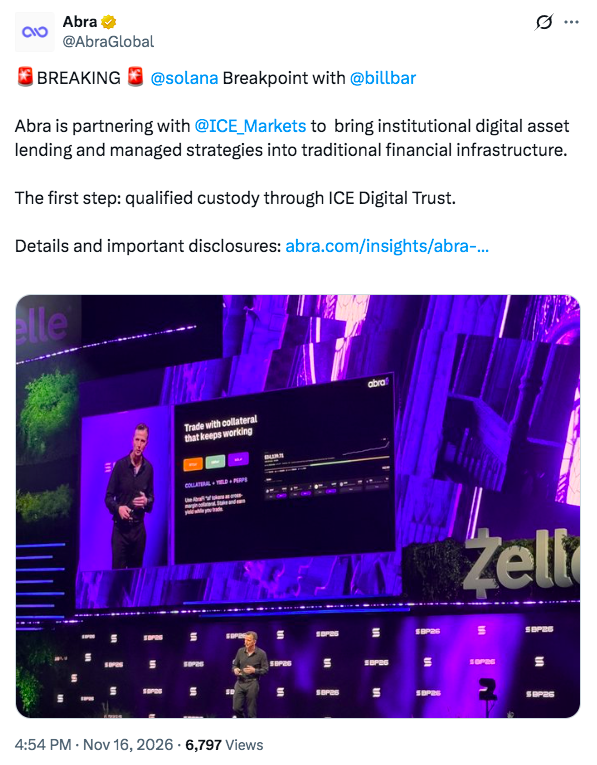
Together, these services could make it easier for eligible institutional investors to incorporate Bitcoin into broader financial strategies.
Could Bitcoin-Backed Lending Strengthen Institutional Demand?
The growing availability of Bitcoin-backed financial products represents an important development for the cryptocurrency’s long-term adoption.
Institutional investors increasingly have access to services that go beyond buying Bitcoin through exchanges or investment funds.
They can potentially use Bitcoin as collateral, integrate it into managed portfolios, and access financing through established financial service providers.
Similar innovation has emerged in other sectors, including Bitcoin-backed mortgage products.
For Bitcoin, this expanding infrastructure could create additional incentives for long-term ownership.
Investors who can access liquidity without immediately selling their BTC may have greater flexibility in managing their positions.
However, the announcement does not establish how much Bitcoin has already been pledged or whether the partnership has generated additional BTC purchases.
The program’s long-term impact will depend on institutional participation, lending demand, and the management of collateral risks.
Nevertheless, we believe the ICE and Abra partnership illustrates a meaningful shift in how Wall Street approaches Bitcoin.
Traditional finance is no longer focused exclusively on providing investment exposure to cryptocurrency. It is increasingly developing financial services that allow Bitcoin to function as collateral within established institutional markets.