Grayscale sees Bitcoin buying opportunity as price drops toward $64,000
英文原文查看譯文
閱讀字級閱讀正文 ↓
載入圖片中
Grayscale says Bitcoin's fall near $64,000 offers potential entry points as stablecoin outflows, AI stock weakness and ETF withdrawals weigh on crypto.



Share
Grayscale has described the cryptocurrency market’s November selloff as a potential buying opportunity for longer-term investors after Bitcoin fell about 17% to roughly $64,000.
• Grayscale sees current crypto valuations as attractive after Bitcoin dropped roughly 17% in early November.
• Zach Pandl linked the selloff to stablecoin redemptions, AI stock weakness, and forced futures liquidations.
• Glassnode recorded a $14.2 billion decline in stablecoin supply over 30 days through November 9.
• US spot Bitcoin ETFs lost $2.347 billion across November’s first two complete trading weeks combined.
• Grayscale cited rising institutional stablecoin adoption and tokenization while acknowledging inflation, interest-rate, and geopolitical risks.
Grayscale head of research Zach Pandl, in a Monday research note, attributed the decline to stablecoin conversions into fiat currency and weakness in artificial intelligence stocks, with leveraged liquidations worsening the losses. The firm’s market-cap-weighted Crypto Sectors index lost roughly 18% during the first two weeks of November, with Bitcoin and Solana among the weakest large cryptocurrencies after adjusting for volatility.
Grayscale links crypto selloff to stablecoin withdrawals
Pandl identified withdrawals from dollar-linked stablecoins as one possible cause of the selling. He reported that the circulating supply of Circle’s USDC began contracting in early October, while Tether’s USDT subsequently traded below its dollar peg. The decline in stablecoin supply accelerated after the October 29 security breach at Binance.
In his assessment, “some investors may be temporarily exiting digital assets” following the security incidents, moving funds toward conventional banking services. Grayscale nevertheless considers stablecoins complying with the US GENIUS Act, including USDC, to be relatively low-risk instruments. The report did not establish how much of the stablecoin contraction directly resulted from the Binance incident.
Separate research supports the reported decline in available liquidity. Glassnode’s November 11 market report found that stablecoin supply had fallen $14.2 billion over 30 days through November 9, the fastest contraction since June 2022. As crypto.news previously reported, shrinking stablecoin balances coincided with weaker Bitcoin demand and continued withdrawals from exchange-traded funds.
The decline followed several weeks of reduced capital entering the cryptocurrency market. Glassnode reported that Bitcoin’s Coinbase premium remained negative, indicating that US investors were paying less for the cryptocurrency on Coinbase than traders on other major exchanges.
AI stock weakness adds to Bitcoin selling pressure
Pandl’s second explanation involved the retreat in Nvidia and other AI-linked shares. Investment portfolios holding both technology stocks and cryptocurrencies may have reduced exposure to riskier assets as confidence in AI-related companies weakened, he wrote.
The report drew attention to a connection between the industries beyond their presence in investment portfolios. Bitcoin mining companies increasingly compete with AI data-center operators for electricity and computing infrastructure, with some miners supplying computing capacity to AI businesses. Grayscale argued that weaker investment expectations for AI could affect those infrastructure providers.
The cryptocurrency market’s November 13 selloff coincided with renewed technology-stock selling, pushing Bitcoin below $70,000. The downturn continued during the weekend as traders reduced leveraged positions amid limited liquidity.
Bitcoin had crossed below its 200-day moving average on November 12. Pandl said trend-following funds sometimes use that indicator as a selling signal, while falling prices forced traders to close leveraged perpetual futures positions.
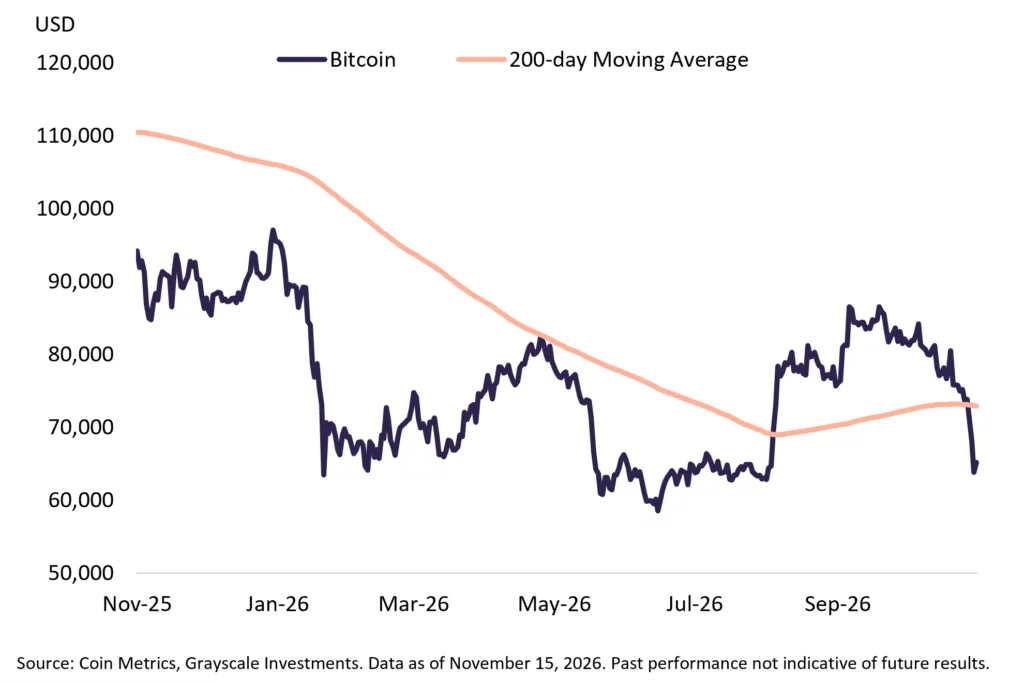
Source: Grayscale
The market subsequently traded as low as $62,029 on November 15 before recovering toward $64,000. A November 16 price assessment described a collapse in futures open interest and continued uncertainty surrounding US interest rates and technology shares.
Bitcoin ETF withdrawals continue despite Grayscale’s assessment
Grayscale characterized withdrawals from cryptocurrency investment products as a secondary contributor that did not appear exceptionally large. Fund-flow records nevertheless show sustained withdrawals during the same period.
Farside Investors data show US spot Bitcoin ETFs lost $1.282 billion during November 2–6, followed by another $1.065 billion during November 9–13. The two-week total reached $2.347 billion. BlackRock’s IBIT accounted for $908.4 million of the second week’s withdrawals, when every trading session finished negative.
The pressure was not limited to Bitcoin funds. Ethereum ETFs lost $398.9 million during November 9–13, while funds tracking Solana, Zcash and Hyperliquid recorded additional withdrawals. Across those five cryptocurrency fund groups, weekly outflows totaled $1.5314 billion.
Glassnode said an ETF withdrawal period measured through November 9 remained smaller than several previous episodes. Its report identified weak US spot demand despite some accumulation among Bitcoin wallets holding between 100 and 10,000 BTC.
Grayscale maintains positive outlook despite macro risks
Pandl said Grayscale’s proprietary indicators suggested that crypto asset “valuations have swung rapidly from overbought to oversold.” The assessment accompanied the firm’s longer-term expectations for digital assets despite the continuing price decline.
The asset manager identified institutional adoption of stablecoins and tokenized financial assets as positive developments. It views continuing government deficit spending as another factor supporting demand for alternative stores of value.
Pandl nevertheless acknowledged uncertainty surrounding AI investment, persistently high inflation, possible additional Federal Reserve rate increases and geopolitical conflict.
Grayscale maintained that “current prices represent compelling entry points” for investors with medium- and longer-term holding periods.
The firm disputed theories attributing the selloff primarily to Anthropic’s planned public offering or pressure on Bitcoin treasury company Strategy. Its report noted that MSCI had announced on November 11 that Strategy would be removed from its benchmark indexes effective November 30, while Strategy’s variable-rate preferred security STRC continued trading near par.