Wall Street Stocks Enter Solana DeFi As Jupiter Unveils New Lending Market
Translation is unavailable. Showing the English original.View English original
Reading sizeRead report ↓
Loading image
Solana is taking another important step toward connecting traditional financial markets with decentralized finance. Jupiter has announced a partnership with publicly traded cryptocurrency company Bullish to introduce a lending market where eligible investors will be able to borrow against tokenized shares listed on the New York Stock Exchange. The announcement, made during the Solana Breakpoint […]

Solana is taking another important step toward connecting traditional financial markets with decentralized finance. Jupiter has announced a partnership with publicly traded cryptocurrency company Bullish to introduce a lending market where eligible investors will be able to borrow against tokenized shares listed on the New York Stock Exchange.
The announcement, made during the Solana Breakpoint conference in London on November 16, expands the blockchain’s growing role in tokenized financial assets.
Unlike conventional cryptocurrency lending, the proposed market will allow qualifying holders of Bullish shares to use their tokenized equity as collateral without necessarily selling their investment.
The development builds on Solana’s expanding presence in traditional finance, following the recent announcement of a tokenized stock trading platform planned for the network.
Jupiter Brings Wall Street Shares Into Solana Lending
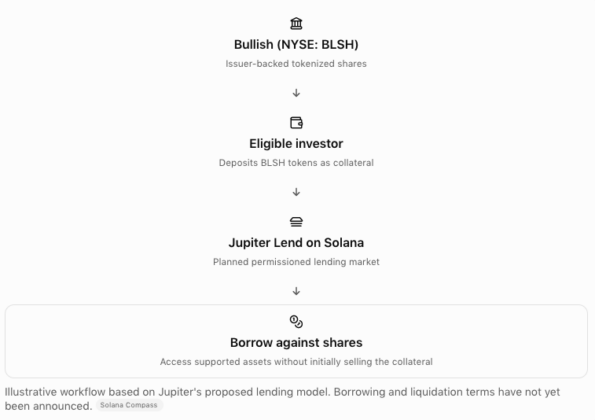
Jupiter confirmed that it is working with Bullish to introduce a dedicated, permissioned lending market on Jupiter Lend.
The platform will initially support Bullish’s NYSE-listed shares, trading under the ticker BLSH, with additional issuer-backed tokens expected to follow.
The distinction is particularly important because Bullish’s tokenized shares are issued with the company’s involvement rather than simply representing synthetic exposure to its stock.
Under the proposed system, eligible shareholders could deposit their tokenized BLSH shares as collateral and borrow supported assets against them.
The arrangement could provide access to liquidity while allowing investors to maintain their underlying equity exposure, subject to borrowing costs and liquidation risks.
Jupiter has not announced a confirmed launch date, collateral requirements, or borrowing rates.
Nevertheless, we believe the partnership demonstrates how blockchain infrastructure could make traditional financial assets more useful.
The official Solana account highlighted the announcement on X, introducing Jupiter’s broader infrastructure expansion.

Why Tokenized Stocks Could Become Important For DeFi
The tokenization of traditional financial assets has attracted growing interest from institutions seeking more efficient settlement, improved accessibility, and new ways to manage collateral.
However, bringing shares onto a blockchain is only the beginning.
Jupiter COO Kash Dhanda highlighted the difference between simply issuing tokenized assets and making them useful within financial applications.
During the Breakpoint presentation, Dhanda discussed an estimated $460 billion in tokenized assets, with only approximately $3.4 billion being used in decentralized finance.
These figures suggest that a substantial amount of tokenized financial value has yet to become actively integrated into DeFi applications.
For Solana, the opportunity is significant.
If more tokenized assets can support lending, collateral management, and settlement, the network could attract additional financial activity beyond conventional cryptocurrency trading.
Jupiter’s proposed market provides one example of how this transformation could develop.
Solana Expands Its Institutional Finance Infrastructure
Alongside the Bullish partnership, Jupiter introduced two additional services designed to support tokenized financial products.
The first, Jupiter Global Passport, is intended to simplify identity verification for users accessing permissioned financial markets.
The second, Jupiter Liquidity Services, aims to help asset issuers establish trading markets, attract liquidity providers, and connect their products with Jupiter’s existing infrastructure.
Together, these services address three important challenges: investor eligibility, market liquidity, and access to lending.
This is particularly relevant as more traditional financial institutions explore public blockchain networks.
Solana’s relatively low transaction costs and fast settlement capabilities have already attracted interest from companies developing tokenized securities and other real-world assets.
Jupiter’s latest announcement could strengthen that trend by introducing additional financial services around those assets.
Could This Support Solana’s Long-Term Growth?
The most encouraging aspect of Jupiter’s expansion is that it introduces another potential source of real economic activity to the Solana ecosystem.
Rather than relying exclusively on cryptocurrency trading, the network could increasingly support financial services involving equities, investment funds, and other traditional assets.
If the Bullish lending market attracts meaningful participation, it could generate additional transactions and encourage more issuers to explore Solana-based financial products.
However, the immediate impact on SOL’s price remains uncertain.
The lending market has not launched, and its future activity will depend on institutional participation, regulatory eligibility, collateral requirements, and market demand.
A successful rollout would not automatically translate into higher SOL prices, but it could strengthen the network’s long-term utility.
For investors, the more important development is the expanding range of financial applications being built on Solana.
As traditional shares become usable within blockchain-based lending systems, Solana could strengthen its position in the emerging market for tokenized financial infrastructure.
Jupiter’s partnership with Bullish represents another step in that direction, bringing the financial possibilities of tokenization closer to practical use.